
If your home still leans on cool grays and all-white walls, this is the year to warm things up. The defining story across this year’s interior design trends is a clear move away from cold, sterile minimalism toward rooms that feel warm, collected, and genuinely lived in. Designers are favoring natural materials, deeper colors, and personal pieces over anything that looks staged purely for a photo.
Below are the nine trends shaping homes this year, plus the looks that are quietly falling out of favor and a few low-commitment ways to test a trend before you fully commit.

1. Warm, Earthy Color Palettes
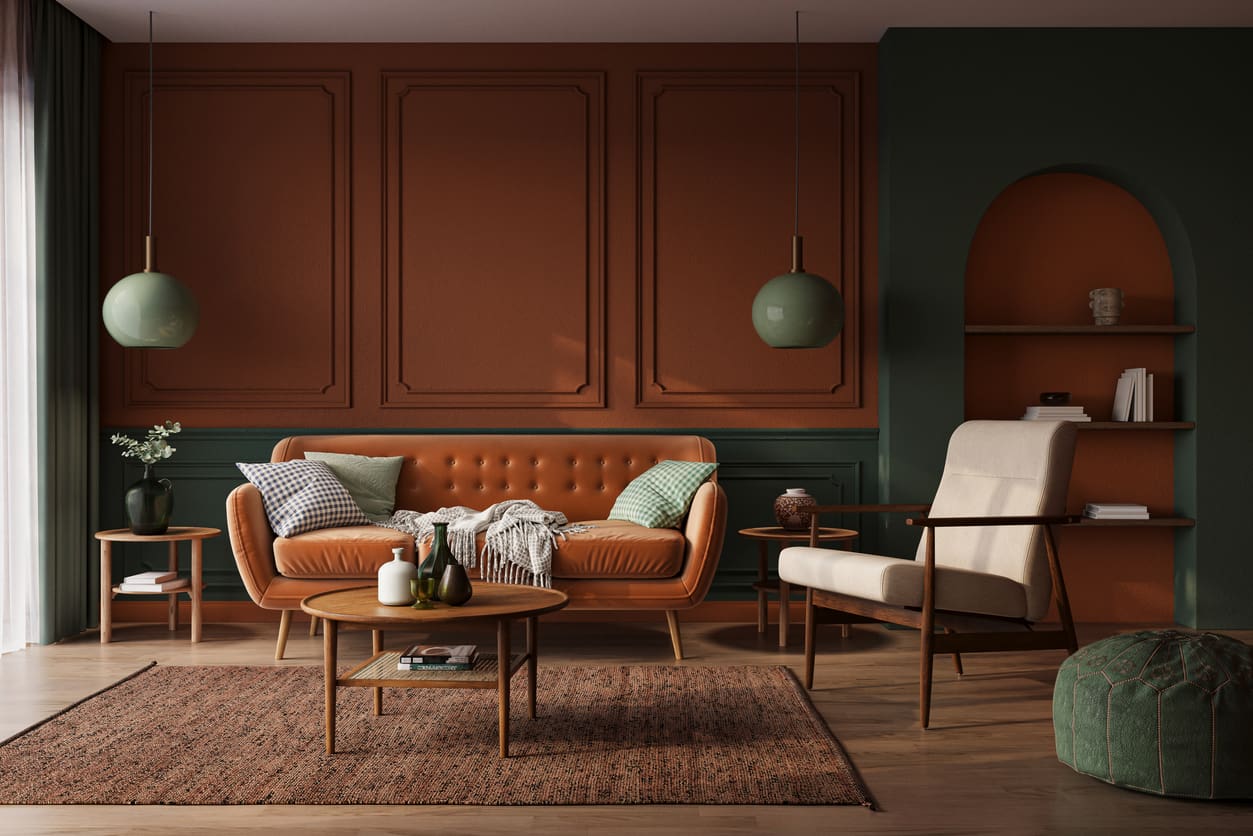
The biggest shift of the year is in color. Cool grays and stark neutrals are being replaced by rich, grounded earth tones that bring depth and comfort to a space. Think espresso brown, iron, olive and moss green, terracotta, and ruddy reds.These palettes feel enveloping rather than clinical, which is exactly the point. You do not need to repaint an entire house to get there. Start with one anchor: a moody bedroom wall, a saturated dining room, or a single piece of furniture in burgundy or petrol blue.
Bold accent shades worth trying
- Burgundy and oxblood for upholstery, fireplace surrounds, and lighting
- Deep olive and moss green for cabinetry and built-ins
- Petrol blue for a statement chair or accent wall
- Chocolate brown as the new “neutral” base
2. Natural, Tactile Materials
It’s all about materials you want to touch. Designers are choosing real, authentic surfaces over decorative imitations: plaster walls, sculptural stone, natural wood, and woven textiles. The trend rewards texture and patina over polish.
A big part of this is materials that age well. Unlacquered brass, bronze, and copper that develop a patina over time are replacing shiny, sealed finishes. The slight wear is the feature, not a flaw. It gives a brand-new room a sense of age and soul.
3. Modern Heritage
Modern Heritage is emerging as one of the year’s signature movements, and it is essentially a bridge between old and new. The idea is to pair classic architectural details, like traditional millwork, inset cabinetry, and historic moldings, with contemporary furniture, hardware, and color.
The result avoids two extremes: it never feels like a museum replica of the past, and it never feels cold or sterile. Character is the foundation, and modern comfort is the finishing layer. Practical examples include inset cabinets under contemporary pendant lighting, or classic door profiles updated with sleek matte hardware.
4. Mixed Wood Tones
The old rule that every wood finish in a room had to match is officially gone. In 2026, designers are deliberately layering light, medium, and dark wood tones in the same space to create depth and a collected, gathered-over-time feeling.
The trick is balance rather than randomness. Pair warm undertones with cooler ones, and let refined grains sit next to more rustic, textured finishes. A light oak floor, a walnut table, and a darker vintage cabinet can absolutely coexist when the tones are intentional.
How to mix wood without it looking messy
- Pick a dominant wood tone for the largest surfaces (floor or main furniture)
- Repeat each secondary tone at least twice so it reads as intentional
- Keep undertones in the same family (all warm or all cool) when in doubt
- Use a rug or textile to bridge two contrasting woods

5. Pattern & Color Drenching
After years of minimalism, pattern is back in a meaningful way. Color drenching wraps a single shade across walls, trim, and even the ceiling for an immersive, cocooning effect. Pattern drenching layers multiple patterns in one space.
Pattern drenching does not mean repeating one print everywhere. The more sophisticated version mixes patterns that talk to each other without matching: florals with stripes, an antique rug under patterned upholstery, textiles that share a palette but not a print. A related micro-trend is “color capping,” where an intense color goes on the ceiling to warm the whole room from above.
6. Curved, Soft Shapes
Sharp angles and rigid geometry are softening. Curved sofas, rounded profiles, arched doorways, and sculptural silhouettes are showing up everywhere, creating spaces that feel more open and welcoming. Soft forms also make smaller, multifunctional rooms feel less boxed in.
One caution: a few designers expect the most extreme curved sofas to date quickly. If you want the look but worry about longevity, get the curve in a smaller, easier-to-swap piece, an accent chair, a mirror, a coffee table, rather than the most expensive item in the room.
7. Layered, Lived-In Spaces (Thoughtful Maximalism)

The single biggest theme of 2026 is personality. Designers are moving decisively away from cookie-cutter, trend-chasing rooms toward deeply personal, layered spaces that reflect the people who live in them. The phrase you will hear repeatedly is “lived-in luxury.”
In practice this means collected objects, heirlooms, vintage finds, travel souvenirs, and books displayed in styled vignettes on shelves and coffee tables. Each piece ideally tells a story. This is “thoughtful maximalism“: more is welcome, but it is curated, not cluttered.
8. Grandma Chic and Vintage Details
A softer, more decorative aesthetic is having a moment, often called “Grandma Chic.” It shows up as small-scale floral fabrics, ruffled or pleated skirts on upholstery, shirred lampshades, and plenty of wallpaper. The new version is elegant and intentional rather than fussy.
Supporting details are coming along for the ride: thick, gilded vintage picture frames replacing thin minimalist ones, heirloom-style textiles used as throws or even headboard fabric, and decorative motifs like swans appearing across decor and even fashion.
9. Wellness and Aging-in-Place Design
Homes are increasingly designed around well-being and longevity. More homeowners are planning for aging in place and multigenerational living, building in features like curbless showers and grab bars during renovations, often without sacrificing style.
The work-from-home shift also continues to influence layouts. After years of open-concept everything, there is renewed demand for “closed-off” rooms, a home office with a real door, a quiet reading nook, spaces that support focus and calm rather than constant openness.
What Styles Are On the Way
Trends are as much about subtraction as addition. Designers are nearly unanimous on what they are ready to leave behind this year:
- All-white and sterile rooms. Stark, mostly white environments feel cold next to this year’s warmth.
- Cool gray everything. Earth tones have replaced gray as the default neutral.
- Rooms designed only for social media. If a space is built purely to photograph well, it rarely holds up in daily life.
- Overly themed, one-note interiors. Layered and personal beats matchy and themed.
- Faux finishes. Imitation stone and decorative fakes are losing to authentic materials.
How to Try a Trend Without Overcommitting
You do not have to gut a room to feel current. The smartest approach is to treat trends as accents on top of a timeless foundation. Keep your big investments, sofas, flooring, cabinetry, relatively classic, then layer trends through items that are easy and affordable to change later.
Low-risk ways to test the looks:
- Swap in a few earth-toned throw pillows or a moody lampshade before repainting
- Add one vintage frame or heirloom textile to an otherwise modern wall
- Color-drench a small, low-stakes room like a powder room or entry first
- Introduce an unlacquered brass accessory and let it patina
For more on building that timeless base, see our guides on interior design tips that actually work and our room-by-room interior home design guide.
Frequently Asked Questions
What is the biggest interior design trend right now?
Warmth. Across colors, materials, and styling, 2026 is defined by a move away from cold minimalism toward warm, earthy, lived-in spaces with natural materials and personal pieces.
What colors are trending in 2026?
Rich earth tones lead the year: espresso brown, olive and moss green, terracotta, iron, and ruddy reds, with bold accents like burgundy and petrol blue. Cool grays and stark whites are on the way out.
Is minimalism out?
Cold, sterile minimalism is fading, but the answer is not clutter. The trend is “thoughtful maximalism,” layered and personal spaces that are curated rather than chaotic.
How do I update my home on a budget?
Start with low-cost accents: earth-toned textiles, a vintage frame, unlacquered brass hardware, or color-drenching a small room. Keep big-ticket items classic and let trends live in pieces that are easy to swap.
Last updated: August 28, 2026
This post contains affiliate links. If you use the link, I may earn a commission-at no extra cost to you
About Marney Dornan